Château Franc Capet

A small family estate, two Right Bank terroirs and wines made in deliberately limited quantities.

Sarah and Éric welcome you to Fronsac. Here, every cuvée comes from a specific plot and attentive work, from the vineyard through to the bottle.

0.72 haon a human scale
2 AOCsFronsac & Canon Fronsac
Harvestby hand
Château Franc Capet in Fronsac
Fronsac · Gironde
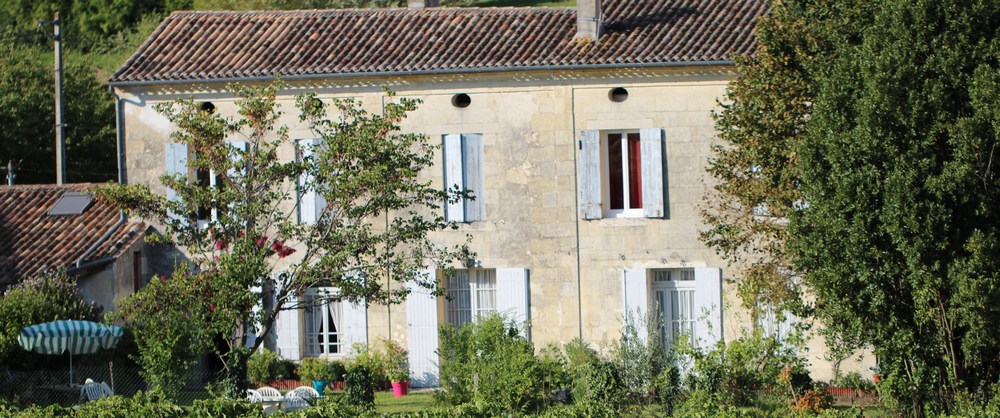
The Château Franc Capet house in Fronsac
The setting

A family estate in the Fronsadais.

Château Franc Capet lies amid the rolling landscape of Fronsac, with limestone slopes, narrow vineyard roads and nearby rivers. The estate deliberately remains small, allowing every row to be monitored with precision.

Visitors receive a warm, informal welcome, with time to discuss the plots, our winegrowing choices and the available vintages.

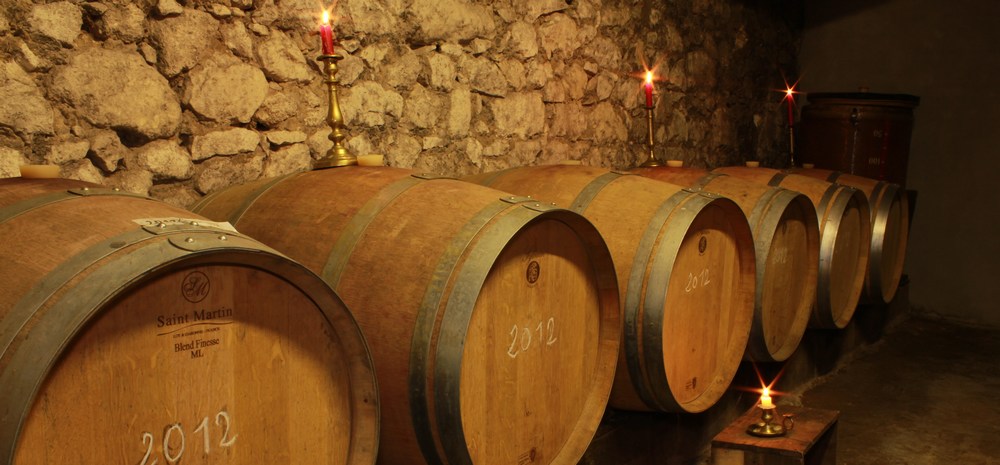
Barrels in the Château Franc Capet winery
The winery

Careful ageing that lets the fruit shine.

Our work in the winery enhances the character of the wines without masking it. Ageing is designed to preserve their body, freshness and precision, with particular attention paid to the Canon Fronsac lots.

Limited production allows us to follow every wine carefully, from grape to bottle.

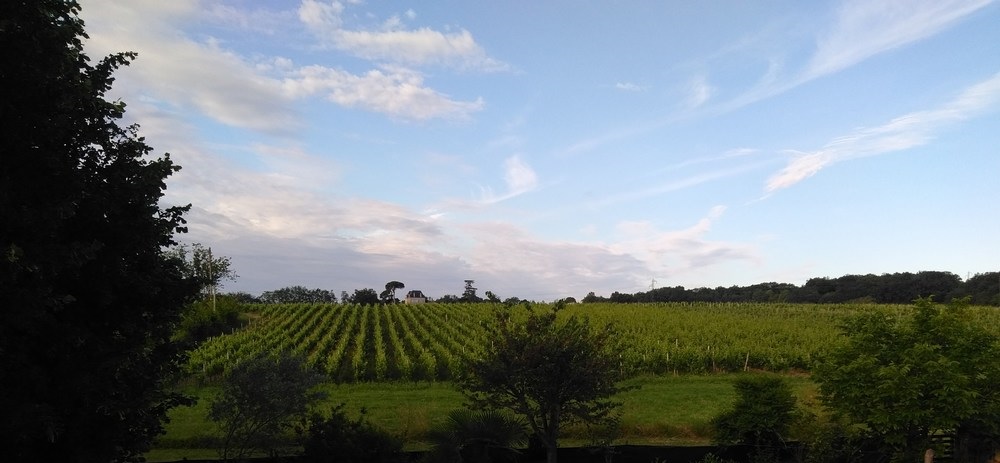
The Palaka plot in Canon Fronsac
The vineyards

Capet and Palaka, two complementary plots.

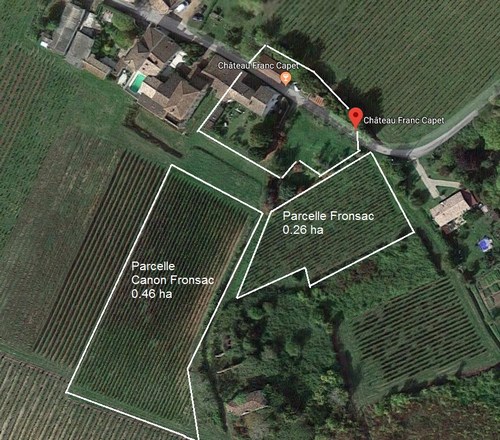
Capet embodies the estate’s historic roots in Fronsac, while Palaka expresses the more exclusive identity of Canon Fronsac. The two plots offer different interpretations of the same area, combining Merlot’s roundness, depth and ageing potential.

Working a small surface area keeps us close to the vines and lets us adapt each intervention to the rhythm of the vintage.

A convivial moment shared over Fronsac wines
Our spirit

A wine shaped by place, heritage and encounters.

Château Franc Capet is also a story of sharing: a family heritage carried forward, a Right Bank terroir still waiting to be discovered, and conversations with visitors, wine lovers and loyal customers.

Every bottle extends this direct bond between the estate, its history and those who taste its wines.

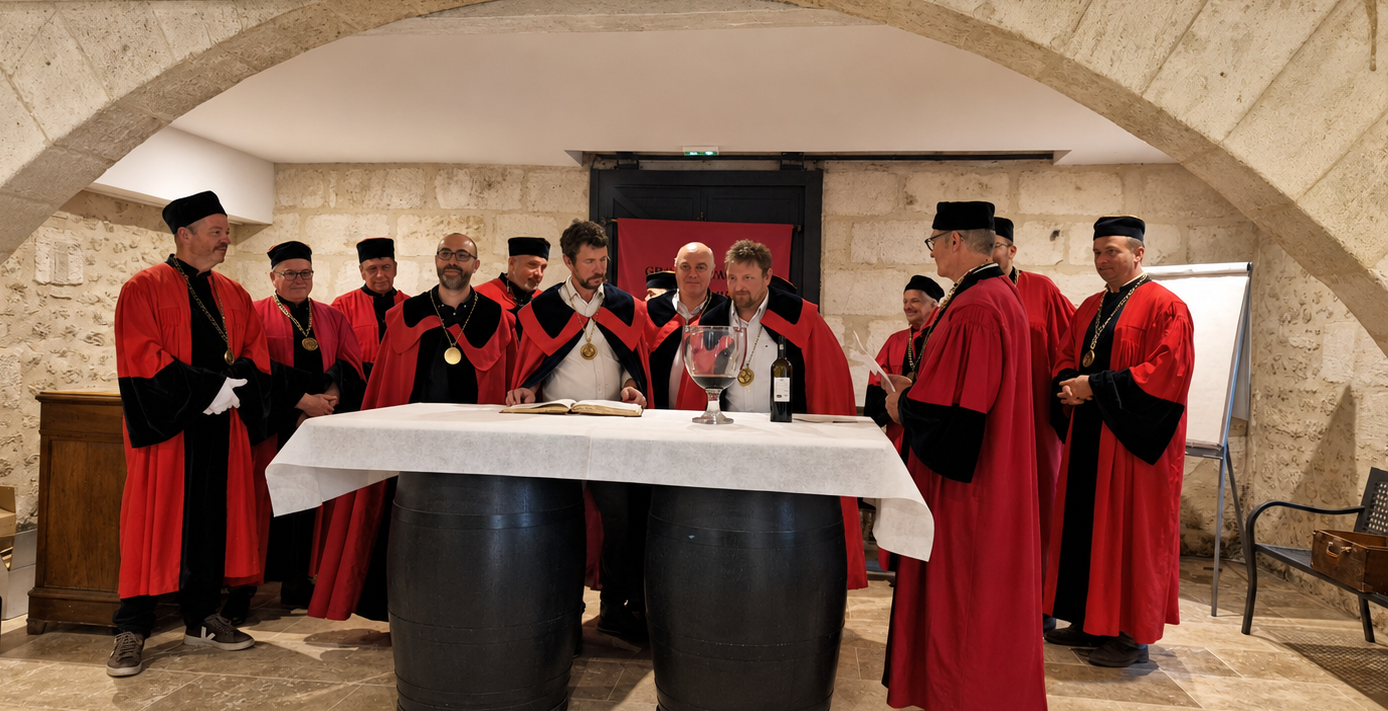
Here I am, in the centre of the second row, on 23 April 2026, at my induction into the Confrérie des Gentilshommes de Fronsac.

Three generations, one place.

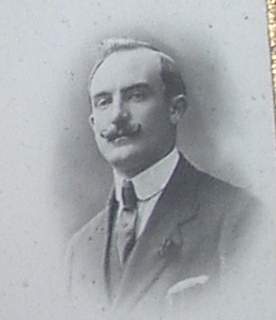
The story of Château Franc Capet began with Uncle Philippe, passed to Gérald Risser-Maroix in 1981 and has continued with Éric Risser-Maroix since 2008. A family story shaped by transmission, learning and a lasting attachment to the terroir of Fronsac.

My uncle Philippe

The origins

Uncle Philippe

The story begins in 18XX with my uncle Philippe Marroix at a place called “Capet”, in the commune of Fronsac. My uncle owned a large vineyard, producing both white and red wine. He was also a beekeeper and made mead. We have kept his old labels.

His only son was accidentally killed while hunting. Philippe then began selling the estate plot by plot, until the day he discovered that he had a nephew: my father, Gérald Risser Maroix. By then, only one tiny plot remained, named Capet. My uncle kept it and made his wine there: Château Franc Capet.

My father in the Capet vineyard

1981

Gérald Risser-Maroix

When my uncle died in 1981, my father inherited the estate. A technology teacher in Toulouse, he could not manage it himself and leased it to a friend. When he retired, he took the vineyard back and began working the land.

He learned about viticulture and winemaking. The first year was not very successful, but he persevered and continued learning. From the second year until his death, he obtained the coveted Fronsac Appellation d’Origine Contrôlée. Château Franc Capet AOC Fronsac was then sold to friends and family.

Welcome

Since 2008

Éric Risser-Maroix

I worked in IT in Paris before leaving the profession in 2008 to take over the estate. Like my father, I began with almost no winegrowing knowledge. I also expanded the estate in the hope of making a living from it. It was a considerable challenge.

In 2008, I trained for a year at Château La Tour Blanche, a Sauternes Premier Cru Classé, alternating with practical experience at a friend’s estate in Fronsac. In 2009, I earned a vocational qualification in viticulture. In 2010, I founded my business, bought half a hectare in Canon Fronsac, removed the abandoned vines and replanted in July. The plot produced its first wine in 2012, earning a Gilbert & Gaillard Gold Selection.

There was no production in the disastrous 2013 vintage. To pay the bills, I returned to IT. Since then, I have worked at a computer during the week and at the wine estate on Saturdays and Sundays. Time flies.

Clay-limestone soils, pronounced relief and the influence of the Isle and Dordogne rivers.

Fronsac and Canon Fronsac form a landscape of hillsides where limestone, clay and rivers give the red wines their balance of depth, freshness and ageing potential.

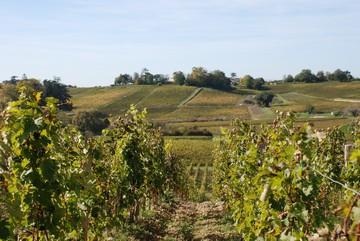
Landscape of the Fronsac appellation
A shared terroir

A Right Bank area shaped by plateaus, slopes and valleys.

At the confluence of the Isle and Dordogne rivers, Fronsac and Canon Fronsac lie on limestone plateaus, clay-limestone slopes and occasional clay-silica foothills. Asteria limestone defines the mounds and plateaus, while Fronsadais molasse shapes the slopes and valleys.

Working the vineyard soil
Soils

Asteria limestone and Fronsadais molasse

This clay-limestone combination provides a steady water supply without excess or sudden stress. The hillsides enhance natural drainage, contributing richness, depth and complexity to the wines.

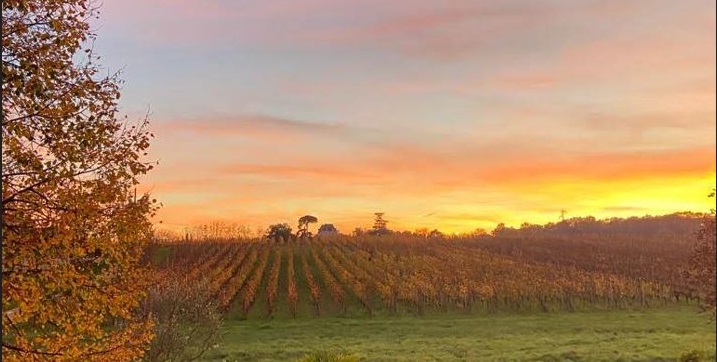
Fronsac vines in autumn
Climate

Slow ripening, protected by two rivers

The temperate oceanic climate is slightly more continental here than in other parts of Bordeaux. Long summers, mild autumns and the influence of the Isle and Dordogne promote ripeness while limiting spring frosts.

Vines in the Palaka plot in Canon Fronsac
Grape varieties

Merlot as the common thread

Merlot is by far the dominant variety in both appellations, thriving in the cool clay-limestone soils. Cabernet Franc brings finesse, freshness and structure, while Cabernet Sauvignon is best suited to the warmest, driest plots.

The Capet plot in Fronsac
Two AOCs

Fronsac to the north, Canon Fronsac to the south

Fronsac covers around 800 hectares across seven communes. The smaller Canon Fronsac appellation spans approximately 250 hectares around Fronsac and Saint-Michel-de-Fronsac, with particularly pronounced limestone subsoil.

Two appellations, two expressions of the Fronsadais.

Fronsac and Canon Fronsac share an ancient history, pronounced relief and a strong Right Bank identity. At the estate, they are expressed through two plots: Capet in Fronsac and Palaka in Canon Fronsac.

The Capet plot in the Fronsac appellation
AOC since 1937

Fronsac, a historic Right Bank appellation.

Located northwest of Pomerol and Saint-Émilion, the Fronsac appellation extends across seven communes in the Libournais. Its landscape of mounds, plateaus and hillsides overlooks the confluence of the Isle and Dordogne rivers.

The Tertre de Fronsac holds an important place in local history: once a Gallic market, then a Roman site and later a fortress attributed to Charlemagne. In the 18th century, the growing reputation of Fronsac wines accompanied the rise of the Bordeaux wine trade.

  • StyleStructured, fruit-driven reds, often suitable for ageing.
  • Grape varietiesPredominantly Merlot, complemented by Cabernet Franc, Cabernet Sauvignon or Malbec depending on the estate.
  • At our estateCapet, the historic plot: approximately 90% Merlot and 10% Cabernet Franc.
The Palaka plot in the Canon Fronsac appellation
AOC since 1939

Canon Fronsac, the most exclusive area of the Fronsadais.

Canon Fronsac is generally considered the most demanding and sought-after area of the Fronsadais. Smaller than Fronsac and centred around Fronsac and Saint-Michel-de-Fronsac, its limestone plateaus and hillsides produce dense, precise and expressive wines.

Its history is closely linked to the Tertre de Canon and the great limestone terroirs of the Right Bank. The appellation was officially created in 1939 as Côtes de Canon Fronsac, before becoming Canon Fronsac in 1964. It has no official château classification: its reputation rests on the quality of its terroirs, its limited area and the work of its winegrowing families.

  • StyleCharacterful, often more concentrated reds, with body, freshness and firm tannins.
  • Grape varietiesPredominantly Merlot, particularly well suited to clay-limestone soils.
  • At our estatePalaka: a small 100% Merlot plot managed to produce a dense, precise wine.

Available wines, tasting notes and 2026 prices.

Each lot brings together the useful information in one place: appellation, vintage, ageing, tasting notes and ex-cellar prices.

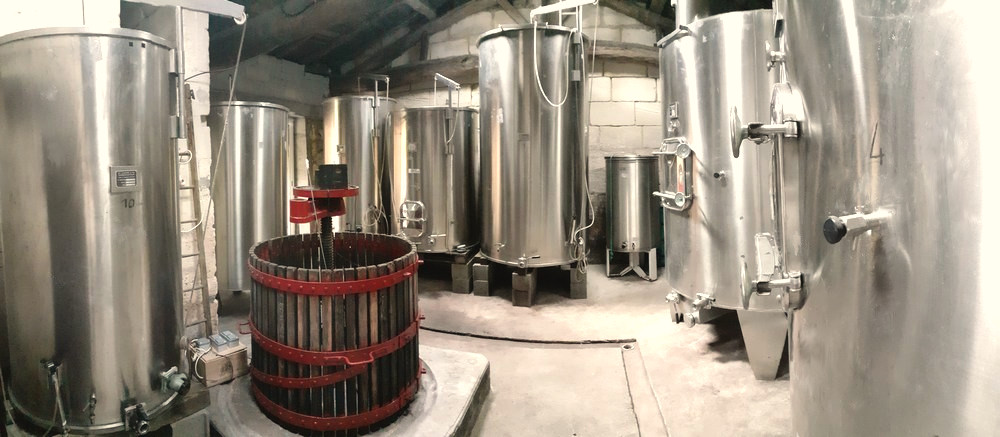
Château Franc Capet vat room
Our wine

Stainless-steel and oak-barrel wines, with careful fermentation monitoring.

For each vintage and appellation, when the harvest is large enough, we make one wine in stainless steel and another aged in oak. One quarter of the barrels used for the oak-aged wine are new, preventing the oak from overpowering the fruit.

Since 2017, stainless-steel coils have regulated the temperature during fermentation. Yeasts convert sugar into alcohol while releasing heat and carbon dioxide: approximately 17 g of sugar is required to produce 1% alcohol by volume. At 14% ABV, the yeasts have consumed 238 g of sugar per litre.

This heat must be dissipated: without temperature control, the vat can rise above 30°C and fermentation may stop. Once the sugars have been consumed, fermentation ends. The vat is then warmed to around 27–28°C for maceration lasting roughly 15 days to three weeks, before run-off, pressing, bottling and tasting.

Our Fronsac is made primarily from Merlot with Cabernet Franc. The estate’s Canon Fronsac is 100% Merlot.
Château Franc Capet Fronsac 2021 label

Fronsac 2021

Lot L3FR21 Stainless-steel vat
Nose
Clean, with ripe-fruit aromas.
Palate
Supple and fruity, with a hint of liquorice and a sound tannic structure.

Gold medal from 70 Millions de dégustateurs, score: 91/100.

1 bottle
€11.00
3 bottles
€30.00
6 bottles
€50.00

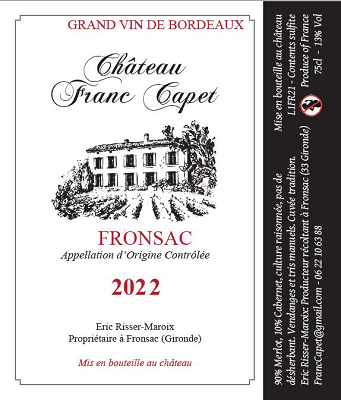
Fronsac 2022

Lot L1FR22 Stainless-steel vat
Appearance
Garnet with violet highlights and moderate intensity.
Nose
Clean, dominated by smoky notes.
Palate
Supple, with slightly tart red-fruit aromas, herbal notes, somewhat rustic oak and slightly limited concentration.
1 bottle
€11.00
3 bottles
€30.00
6 bottles
€50.00
Château Franc Capet Fronsac 2022 label
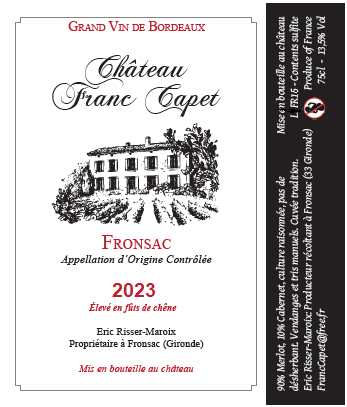
Château Franc Capet Fronsac 2023 label

Fronsac 2023

Lot L2FR23 Oak barrel
Appearance
Garnet with violet highlights and moderate intensity.
Nose
Clean, dominated by smoky notes.
Palate
Supple, with slightly tart red-fruit aromas, herbal notes, somewhat rustic oak and slightly limited concentration.
1 bottle
€13.00
3 bottles
€35.00
6 bottles
€59.00

Canon Fronsac 2020

Lot L2CF20 Oak barrel
Appearance
Deep colour showing the first signs of development.
Nose
Fruity, with black fruit, a hint of kirsch, and oak and toast notes.
Palate
A sweet-fruited entry, good body and slight astringency on the finish.
1 bottle
€17.00
3 bottles
€46.00
6 bottles
€75.00
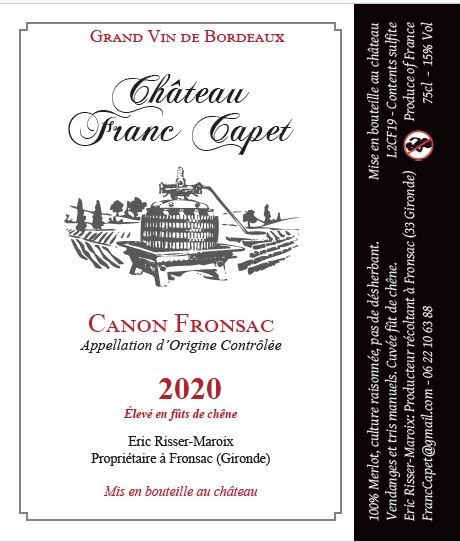
Château Franc Capet Canon Fronsac 2020 label
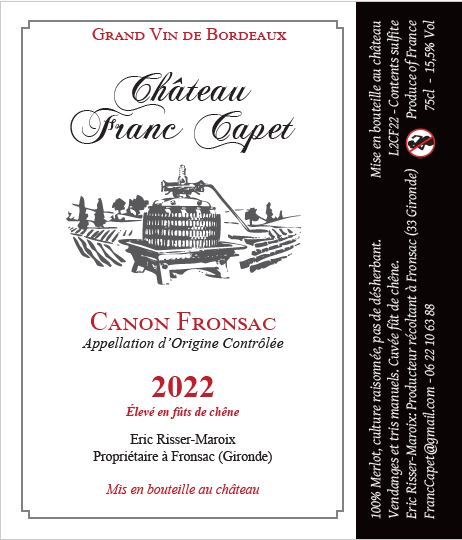
Château Franc Capet Canon Fronsac 2022 label

Canon Fronsac 2022

Lot L2CF22 Oak barrel
Appearance
Deep ruby colour.
Nose
Fruity, with oak and toast notes.
Palate
Sweet fruit, body, integrated tannins and a solid structure.
1 bottle
€17.00
3 bottles
€46.00
6 bottles
€75.00

Canon Fronsac 2023

Lot L2CF23 Oak barrel
Appearance
Deep, vibrant colour.
Nose
Fruity and subtly oaked, with black-fruit notes.
Palate
Supple on the entry, with good body.
1 bottle
€17.00
3 bottles
€46.00
6 bottles
€75.00
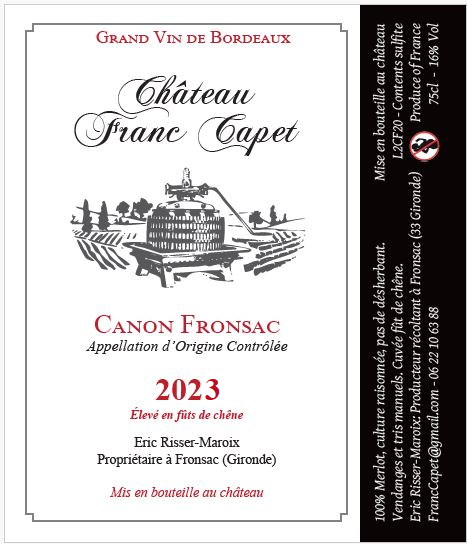
Château Franc Capet Canon Fronsac 2023 label
Order by email

Life and work at the château.

Discover the different stages of our work in the winery, vineyard and winemaking process.

1. The winery

Before making wine, we first had to rebuild a working winery. These videos retrace the transformation of the buildings, the installation of the vats and wine press, and the practical choices that shaped today’s Château Franc Capet winery.

Demolishing the wine press

In 2005, the old wine press and vats were demolished with plans to build a swimming pool and hammam. In 2008, everything changed: Sarah and I decided to create our own wine estate. The future swimming pool then became the new vat room at Château Franc Capet.

The new wine press

After demolishing the old press, a new wine press had to be installed in the adjoining barn. This marked the beginning of a new chapter in the estate’s winemaking activity. Many thanks to our friend Serge for his help.

Bringing the small vats back to Capet

Before the first harvests, we collected some old vats from our friend Rémy, a winegrower in Saint-Aignan. They enabled us to receive and vinify the first crops of this new chapter in the estate’s history.

Installing the large vats in the winery

As the estate expanded from around a quarter of a hectare to two hectares at that time, the small vats were no longer sufficient. Thanks to Rémy, we bought two larger vats. Installing them in the winery required the help of a whole team.

Back to square one — moving the wine press

The press was used in the barn only for the 2008 harvest. Moving the grape pomace to the press and then returning the press wine to the winery proved impractical. We therefore decided to move the press back into the winery, to its original position. Thanks again to Serge.

2. The vineyard

Wine begins in the vineyard. From winter pruning to harvest, these videos show the seasonal work carried out on our small plots: soil cultivation, vine training, replacing missing vines, canopy management and the many precise gestures required throughout the year.

Planting the Palaka plot in Canon Fronsac in 2010

In 2008, we arrived at Capet to begin a new life. I later bought the vineyard opposite the house, which had once belonged to my uncle Philippe: it thus returned to the family estate. Replanted in 2010, the Palaka plot produced its first harvest in 2012, and the wine received a Gilbert & Gaillard gold medal.

Earthing up

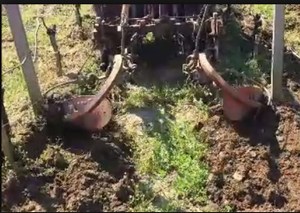
Earthing up consists of bringing soil towards the base of the vines using a soil-working implement. The turned soil covers the weeds beneath the row and limits their growth. When vegetation returns, earthing down reverses the operation.

Earthing down

Earthing down is carried out with an inter-vine cultivator that works the soil beneath the row and between the vines. A feeler detects each vine and causes the blade to retract. Properly securing the vines is essential, as a poorly supported vine may bend under pressure and be damaged.

Pruning

From early December to late February, the vines are pruned using the double Guyot method. Two canes are retained on each vine to prepare the following season’s growth. Bud removal then encourages more upright shoots and good ventilation around the bunches. After pruning, the cut canes are removed or shredded, while a few are kept for barbecues.

Securing the vines

Securing the vines means firmly attaching each vine to the lower wire. Broken or weakened ties are replaced so that the vines can withstand the passage of soil-working equipment, particularly the inter-vine cultivator.

Cane bending and tying

After pruning, the two retained canes are bent and tied to the fruiting wire. This distributes the future shoots along the row and encourages even growth and better distribution of the grape bunches.

Shredding the prunings

The canes removed during pruning are placed in the centre of the row and shredded by the tractor. Once broken down, they gradually decompose and return organic matter to the soil.

Replacing missing vines

Every year, dead or accidentally damaged vines are replaced to keep the vineyard complete and regular. In our narrow rows, where driving the tractor requires considerable precision, replacing missing vines is particularly important.

Trimming

Trimming controls the height and width of the vine canopy during the growing season. The blades rotate at high speed, so this operation requires great care and suitable protection against flying branches and debris.

The harvest

The harvest is the culmination of a full year’s work in the vineyard. Carried out in a friendly atmosphere, it brings together family, friends and participants to pick the grapes that will become the new vintage.

3. Winemaking

Once the grapes reach the winery, a new stage begins. Destemming, alcoholic fermentation, running off, emptying the vats and pressing gradually transform the harvest into wine. These videos offer a simple look behind the scenes at how our vintages are made.

Destemming

The grapes arrive at the winery in a trailer and are unloaded into the reception trough. The bunches then fall into the destemmer, which separates the stems from the grapes. The berries are carried to the must pump and pushed through the large red hose into the vat, where winemaking begins.

Alcoholic fermentation at Château Franc Capet

During alcoholic fermentation, yeasts consume the sugars naturally present in the grape juice and convert them into alcohol, carbon dioxide and heat. Approximately 17 g of sugar per litre are required to produce 1% alcohol by volume. For a wine at 15% ABV, this represents about 255 g of sugar per litre of grape juice. Careful temperature control is essential to support the yeasts until fermentation is complete.

Running off

Once alcoholic fermentation and maceration are complete, the tap at the bottom of the vat is opened to recover the liquid part. This first wine is known as free-run wine. It is pumped into another vat to continue the next stages of winemaking and ageing.

Emptying the vat

After the free-run wine has been drained, the vat still contains the grape pomace, including the skins and seeds. The vat door is then opened and the pomace is removed and transferred to the wine press to extract the remaining wine.

Pressing

We use a ratchet wine press. Under pressure, the wine flows through the openings in the press: this is the press wine. It is generally more tannic, denser and more structured than the free-run wine. It is then pumped into a vat and, depending on the tasting, may be blended with the free-run wine.

Fronsac aperitif

During the summer months of June, July and August, the “Apéros Fronsac” take place once a month on a Thursday. Visitors buy a ticket that allows them to discover and taste wines from the different participating châteaux in a friendly and relaxed evening atmosphere.

Visit Château Franc Capet or prepare an order.

Château Franc Capet, 3 lieu-dit Capet, 33126 Fronsac, France. Please include your telephone number or email address so that we can reply.

From Libourne

Approximately 7 km or 10 minutes, depending on traffic.

From central Libourne, head towards Fronsac, then follow signs for the hamlet of Capet.

From Saint-André-de-Cubzac

Approximately 16 km or 25 minutes, depending on traffic.

From Saint-André-de-Cubzac, head towards Fronsac, then follow signs for Capet.